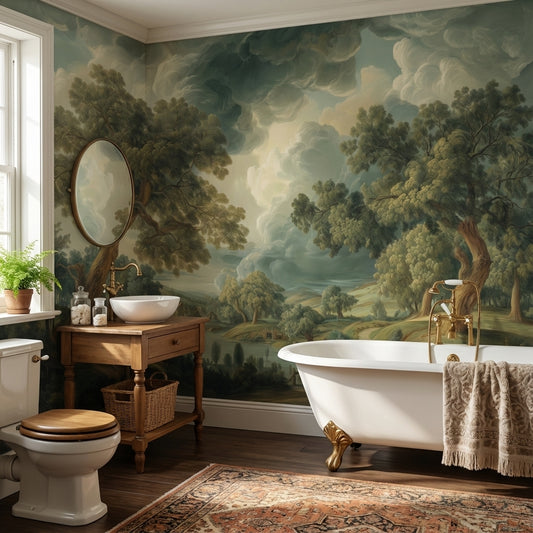
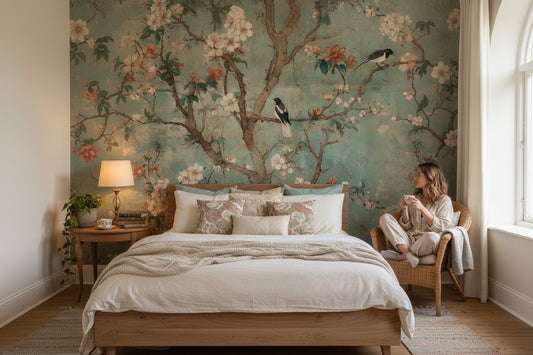
You've found the perfect wall mural. The scene is exactly right. The colors match your room. You're ready to order.
Then you see the measurement fields. Width. Height. Pattern repeat allowance. Suddenly simple becomes complicated.
Measuring walls for custom murals isn't hard, but it's unforgiving. Get it wrong and you either run short mid-installation or spend money on material you'll never use. Neither outcome is good.
Here's how to measure correctly, account for every variable, and order exactly what you need.
What You'll Need
Gather these before you start:
A steel tape measure. Not cloth, not the one on your phone. A proper retractable steel tape, ideally 25 feet or longer. Cloth stretches. Phone apps are inaccurate. Steel tape doesn't lie.
A notepad and pen. Or your phone's notes app. You'll be recording multiple measurements, and you'll forget them if you don't write them down immediately.
A step stool or ladder. If your ceiling is above arm's reach, you'll need to get up there. Guessing at heights from the floor is how people order murals that are six inches too short.
A second person. Optional but helpful. Someone to hold the other end of the tape or write while you measure. Solo measuring works but takes longer.
A level. Not essential for measuring, but useful for checking if your walls and ceiling are actually square. Spoiler: they often aren't.
Measuring Wall Width
Start with width — the horizontal measurement from one edge of the area to the other.
Place the end of your tape at the left edge of where you want the mural. For a full wall, that's the corner or where the wall meets a door frame. Run the tape straight across to the right edge.
Important: measure at multiple heights. Measure at the bottom, the middle, and the top of the wall. Write down all three numbers.
Why? Walls aren't always perfectly straight. A wall might be 120 inches at the bottom and 119 inches at the top. If you only measured the bottom and ordered accordingly, your mural would be slightly too wide at the ceiling.
Use the largest measurement when ordering, then plan to trim excess during installation.
Measuring Wall Height
Now the vertical measurement — from where you want the mural to start (usually where the wall meets the floor or baseboard) to where you want it to end (usually the ceiling or crown molding).
This is where the ladder comes in. Place your tape at floor level and extend it straight up to the ceiling. Have someone read the measurement at the top, or mark the tape and read it after you step down.
Again, measure multiple times. Check the left side, center, and right side of the wall. Ceilings sag. Floors aren't level. Variations of half an inch or more are common, especially in older homes.
Use the tallest measurement for ordering. Trimming excess is easy. Stretching a mural that's too short is impossible.
Accounting for Doors and Windows
If your wall has doors, windows, or other openings, you need to decide how to handle them.
Option one: order as if they don't exist. Measure the full wall width and height, ignoring openings. You'll receive a complete mural and cut out the openings during installation. This ensures pattern continuity across the wall.
Option two: measure around them. Some mural suppliers can customize panels to work around specific openings. You'll provide the opening dimensions and positions, and they'll design the panels accordingly. This costs more but reduces waste and installation complexity.
For most DIY installations, option one is simpler. The material that covers the window will be cut away and discarded, but pattern alignment stays perfect.
If measuring around openings, you'll need:
The opening width and height. Measure inside the frame.
The position. How far from the left wall edge to the left side of the opening. How far from the floor to the bottom of the opening.
Mark these clearly on your diagram.
Understanding Pattern Repeat
Pattern repeat is how often the design duplicates vertically. A mural with an 18-inch repeat means the pattern cycles every 18 inches from top to bottom.
Why this matters: when hanging multiple panels side by side, the pattern must align horizontally. This sometimes requires starting each panel at a slightly different point to match the pattern on the adjacent panel.
For panoramic murals (single images that span the wall), pattern repeat is less relevant. The image is continuous rather than repeating.
For repeating patterns, add extra material to your height calculation. A common rule: add one full pattern repeat to your height measurement. If your wall is 96 inches tall and the pattern repeat is 24 inches, order based on 120 inches of height. This gives you adjustment room.
Creating a Wall Diagram
Before ordering, sketch your wall. It doesn't need to be artistic — just accurate.
Draw a rectangle representing the wall. Label the width at top and bottom if they differ. Label the height on left and right sides if they differ.
Mark any obstacles:
Doors: position, width, and height.
Windows: position, width, and height.
Outlets and switches: position. You'll cut around these during installation.
Light fixtures: position and approximate size.
Unusual features: sloped ceilings, alcoves, columns, anything non-standard.
This diagram helps you visualize the project and serves as reference during ordering. Many mural suppliers ask for diagrams when you're ordering custom sizes.
Common Measurement Mistakes
Measuring only once. Always measure twice minimum. Three times for critical dimensions. Tape measures slip. Numbers transpose in your memory. Verify before ordering.
Forgetting about baseboards and crown molding. If your mural goes floor to ceiling, where exactly? Behind the baseboard (which means removing it)? Starting above the baseboard? Ending at the ceiling or under crown molding? These details change your measurements.
Assuming walls are square. Corners are rarely perfect 90-degree angles. If your mural wraps around a corner, measure each wall separately and note the corner angle if it's noticeably off-square.
Using imperial when the supplier uses metric, or vice versa. Check the order form's units before submitting. Converting incorrectly means receiving a mural that's wildly wrong in size.
Not accounting for trim allowance. Most installers recommend ordering 2-3 inches extra on each edge for trimming. Walls aren't perfectly straight; this allowance lets you cut a clean edge during installation.
When to Hire Professional Measurement
Consider professional measurement if:
The wall has complex architecture — multiple angles, alcoves, unusual shapes.
You're covering multiple walls with a continuous pattern that must align.
The mural is extremely expensive and mistakes would be costly.
You're not confident in your measuring skills.
Some mural suppliers offer measurement services or partner with local installers who will measure for you. The cost is usually modest and provides peace of mind.
For straightforward rectangular walls, DIY measurement is fine. For anything complicated, the professional fee is usually worth the avoided headaches.
Final Checklist Before Ordering
Before clicking "order," verify:
You've measured width at multiple heights and recorded the largest.
You've measured height at multiple positions and recorded the tallest.
You've added trim allowance (2-3 inches per edge).
You've added pattern repeat allowance if applicable.
You've confirmed units match the order form (inches vs. centimeters).
You've noted any obstacles and their positions.
You've double-checked every measurement.
Ordering extra is always safer than ordering short. Many suppliers can't guarantee exact color matching on repeat orders due to printing variations. It's better to have leftover material than to need more and find the new batch doesn't quite match.
Measure carefully once, and the rest of the project becomes much simpler.