

Under warm evening light, Ocean Wallpaper shows more depth than photos usually catch: the blue reads inkier at the edges, while lighter passages open up acro...
Ocean Wallpaper
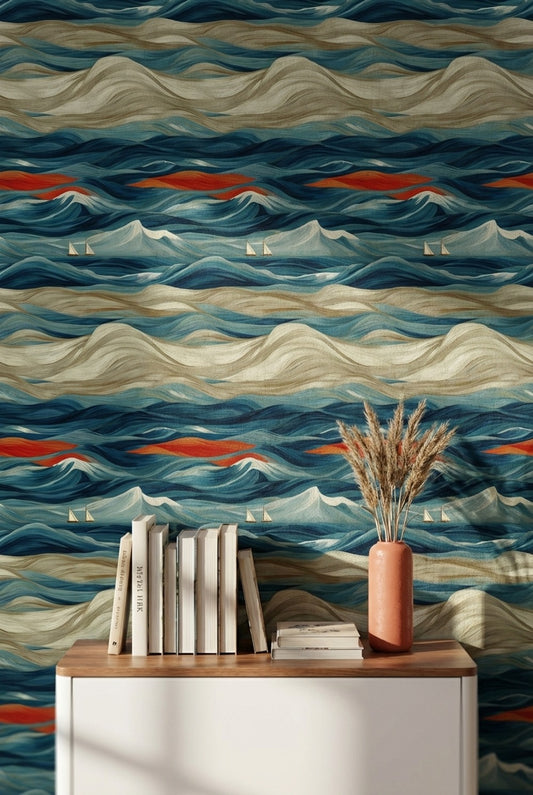
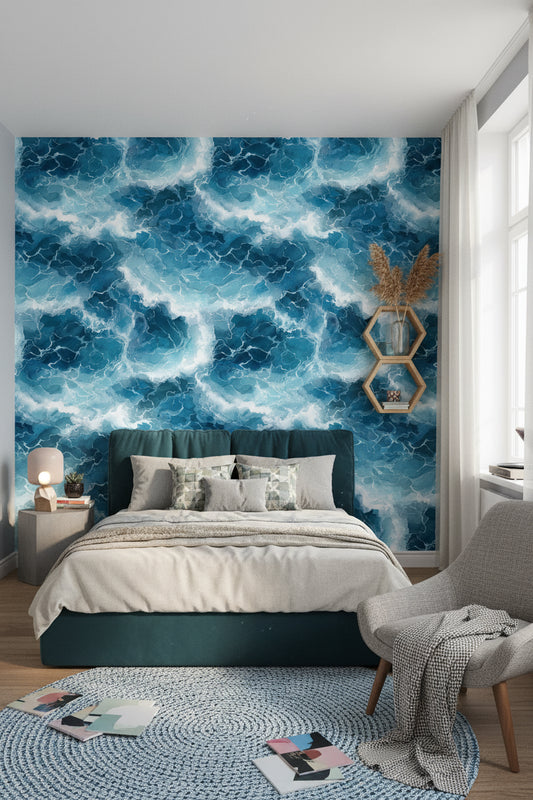
Under warm evening light, Ocean Wallpaper shows more depth than photos usually catch: the blue reads inkier at the edges, while lighter passages open up across the wall so the pattern feels broader from the doorway than it does up close. That shift in scale is useful in larger rooms, where wallpaper for walls needs to hold its shape from across the room without flattening out. In a playroom or bunk room, the same movement gives a lively wallpaper effect that feels active but still ordered, much like the pieces in our Kids Room Wallpaper collection.
How Ocean Wallpaper Balances Inky Blues With Warm Brown Furniture
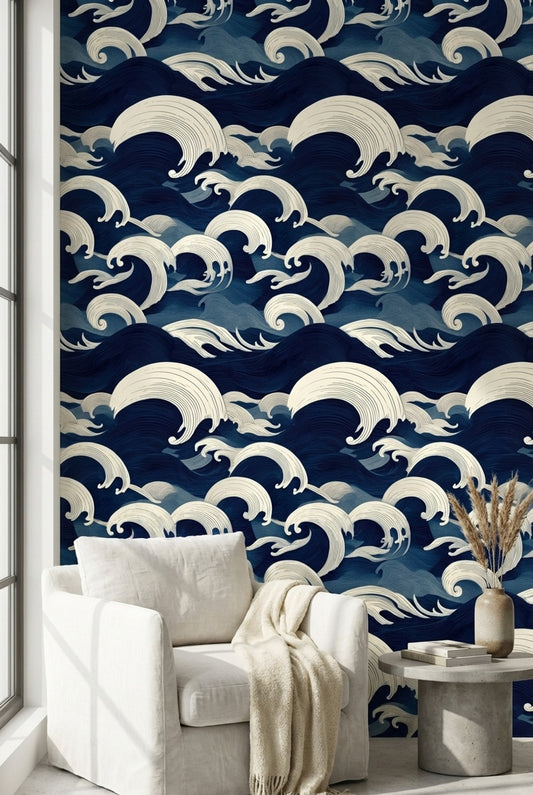
Ocean Wallpaper stands out for its mix of deep navy, slate blue, and washed mineral blue, often grounded by smoky gray undertones that keep the design from turning sugary or bright. Against a walnut sideboard, a tobacco leather lounge chair, or an oak slatted bed, Ocean Wallpaper pulls out the warmth in wood while keeping the wall crisp; if your scheme leans earthier, our Brown Wallpaper collection is a useful companion for adjoining rooms. In open-plan spaces, Ocean Wallpaper can read almost like mural wallpaper because the pattern has a continuous flow, and our guide to Statement Wallpaper For Living Room shows how to pair this kind of large-scale design with low linen sofas and blackened steel coffee tables.
Where Ocean Wallpaper Sits Best in Living Rooms, Bedrooms, and Bathrooms
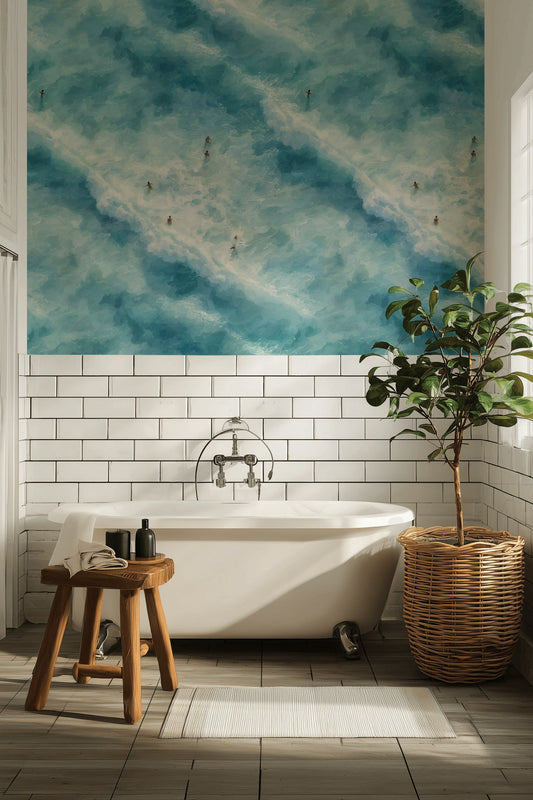
In living rooms, place Ocean Wallpaper on the wall behind the sofa or on the chimney breast so the pattern is framed by furniture instead of interrupted by too many openings; in bedrooms, it is especially effective behind a headboard with ivory bedding and a smoked-oak nightstand. Ocean Wallpaper can even be used as bathroom wallpaper on a vanity wall, and for kitchens, our Modern Wallpaper For Kitchen guide covers layouts where blue-toned kitchen wallpaper sits neatly beside white tile and brushed brass hardware. If you prefer a wall-spanning version, see Ocean Wall Murals; for styling ideas, read Blue Wallpaper Ideas for Calm and Relaxing Interiors, and for family spaces with kids wallpaper energy, the article on Underwater Animal Wall Murals for Creative Spaces is a strong reference. Muralls prints custom sizes, offers paste-the-wall installation, and ships worldwide.
-
wallpaper
Waves Wallpaper.
$23 -
wallpaper
-
wallpaper








57 / 57


— NEED HELP?
Frequently asked questions.
Can't find what you're looking for? Our team replies within 4 working hours, Mon–Fri.
01 What design cues tell me a print belongs in the Ocean Wallpaper collection (not just “blue” decor)?
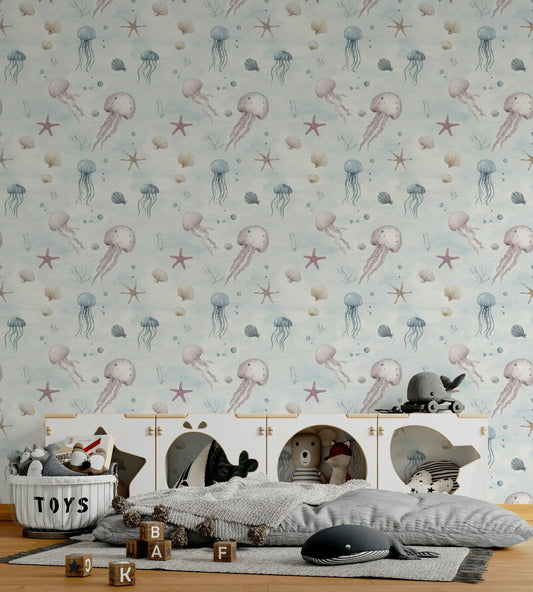
Ocean Wallpaper usually features identifiable sea elements—rolling wave bands, watercolor tide lines, coral silhouettes, sea grass, or horizon gradients in shades like seafoam, aqua, and deep navy. Look for movement and depth (ombre fades, layered wave contours) rather than flat geometric blues. If you want an easy refresh for rentals, many of these looks are available as peel and stick ocean wallpaper.
02 Which room works best for Ocean Wallpaper, and where should I place it (accent wall, full room, or ceiling)?
A nursery or kids’ room is a standout choice—Ocean Wallpaper reads calm and playful at the same time, especially in misty blue and soft sand tones for ocean nursery wallpaper. Put it on the wall behind the crib or bed so the main scene is always in view; in a small room, keep it to one accent wall to avoid visual busyness. For a bolder take, a soft wave pattern on the ceiling can feel like “sky meets sea” without darkening the room.
03 Why is Ocean Wallpaper trending right now, and what makes it feel current rather than coastal-themed?
Current Ocean Wallpaper leans into abstract surf lines, macro textures, and minimal color palettes—think ink-style wave sketches or gradient blues—so it fits modern interiors rather than beach-cottage decor. The popularity of nature-based palettes (navy, slate blue, sea glass) also ties into biophilic design, which people are using to make bedrooms and home offices feel calmer.
04 Should I use Ocean Wallpaper on one accent wall or all walls—how do I decide based on room size and pattern scale?
If the design has a big horizon line or large wave motion, treat it like a focal point: one accent wall works best in rooms under about 120 sq ft, especially behind a sofa or headboard. Smaller repeats (tiny shells, subtle ripples) can handle all four walls in a powder room or hallway without feeling heavy. For commitment-free changes, peel and stick wallpaper ocean options make an accent wall easy to swap later.
05 What furniture materials, finishes, and textiles pair well with Ocean Wallpaper (and what should I avoid)?
Ocean Wallpaper pairs well with light oak or whitewashed wood, a cane-front dresser, and matte black or brushed nickel hardware to keep it crisp. Add textiles like a chunky ivory knit throw, linen curtains in natural flax, and a jute rug to balance cooler blues. Avoid pairing busy sea-life prints with heavily patterned upholstery (like loud florals or tight chevrons), which can compete with the wave movement.
06 Can Ocean Wallpaper mix with other styles, and which combinations work vs. clash?
Ocean Wallpaper works especially well with Japandi (pale oak + clean lines) and modern organic (plaster-look lamps, boucle chairs) because the sea palette stays restrained. It can also lean contemporary when paired with concrete side tables and charcoal accents—great for ocean peel and stick wallpaper in apartments. It tends to clash with high-gloss glam finishes and overly nautical props (anchors, rope motifs), which can make the room feel themed rather than designed.